
Save these dates for our concerts & events
Concerts
“Carols & Tidings” (Music from England, Scotland, and Ireland)
December 12 & 13, 2026
3 pm at Lakeside Presbyterian Church
“How Can I Keep from Singing”
April 17 & 18, 2027
3 pm at Lakeside Presbyterian Church
Come & Sing series
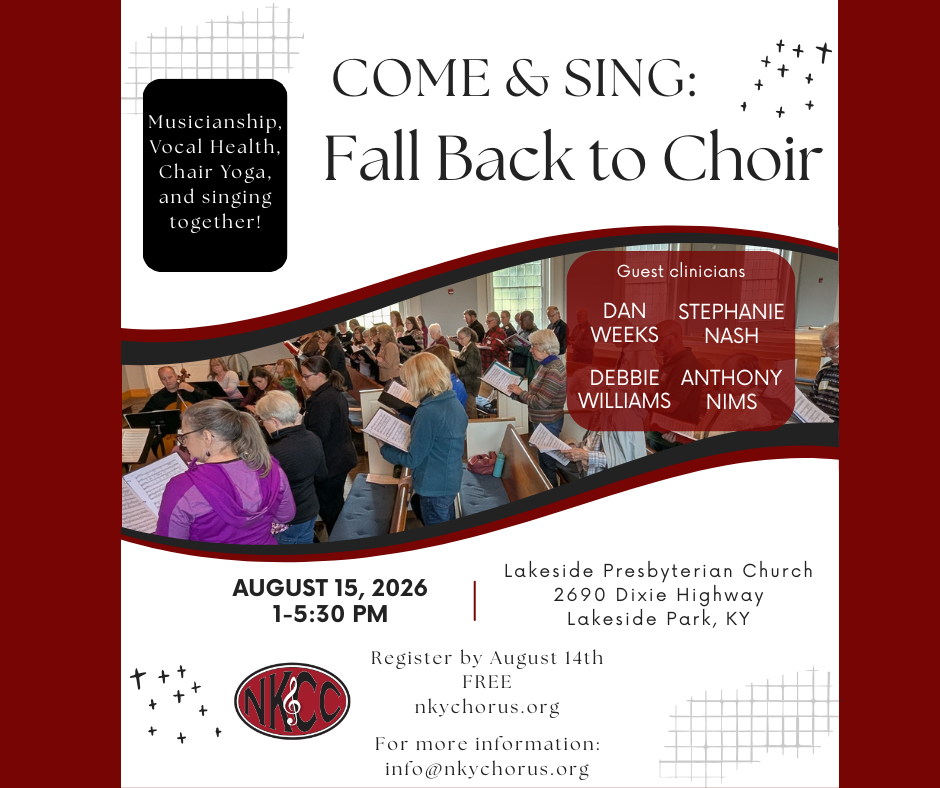
Fall Back to Choir! (FREE registration!)
Get your voice, brain & body tuned up for the fall choral season with guest clinicians:
Dan Weeks (Professor of Voice, UC-CCM)
Anthony Nims (Director of Choral Activities, Walnut Hills High School)
Debbie Williams (Yoga Instructor)
Stephanie Nash (Artistic Director, Northern Kentucky Community Chorus)
August 15, 2026
1-5:30 pm at Lakeside Presbyterian Church
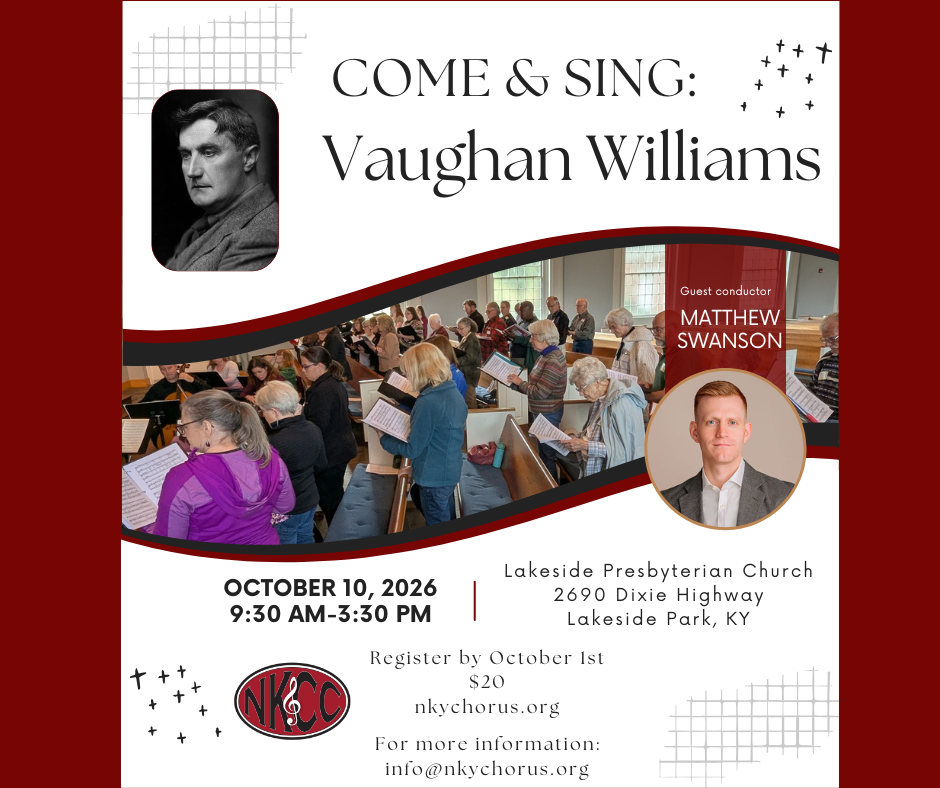
Come & Sing: Vaughan Williams
with Dr. Matthew Swanson (Director of May Festival Choruses)
October 10, 2026
9:30-3:30 pm at Lakeside Presbyterian Church
$20 (lunch & music included)
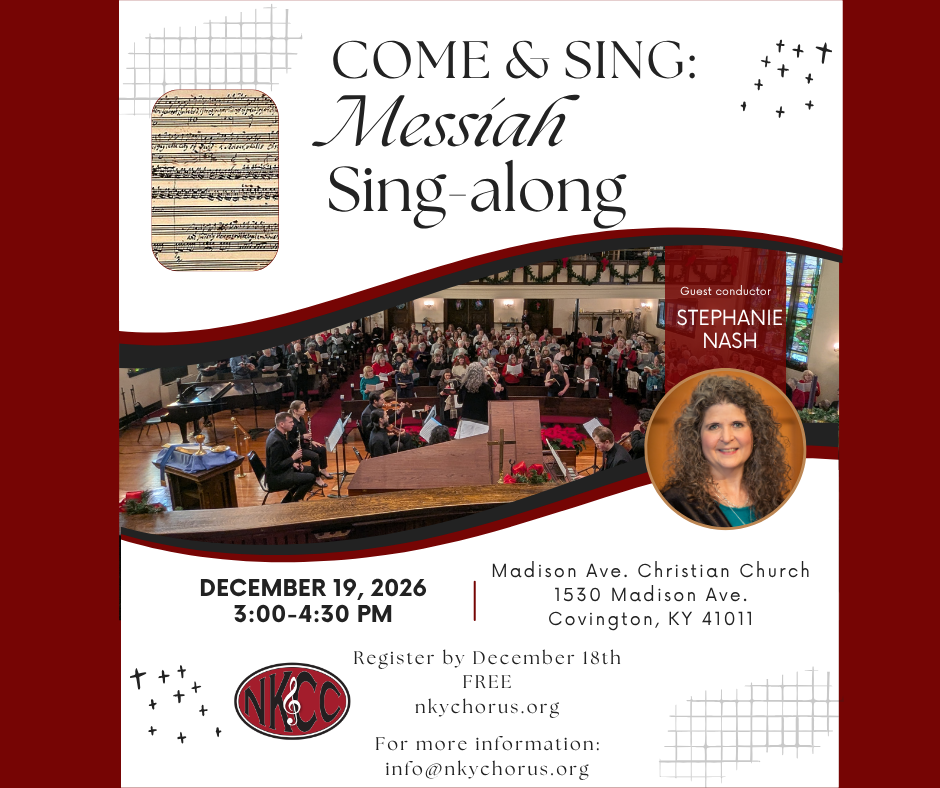
Come & Sing: Messiah sing-along
with Stephanie Nash (Artistic Director of the Northern Kentucky Community Chorus)
December 19, 2026
3:00-4:30 pm at Madison Ave. Christian Church, Covington
Register HERE; FREE!
Come & Sing: Mozart
with Dr. Brett Scott (Professor of Ensembles and Conducting, UC-CCM)
April 10, 2027
9:30-3:30 pm at Madison Ave. Christian Church, Covington
Register HERE; $20 (lunch & music included)
Singing in a chorus is good for you
“ The physiological benefits of singing, and music more generally, have long been explored. Music making exercises the brain as well as the body, but singing is particularly beneficial for improving breathing, posture and muscle tension. Listening to and participating in music has been shown to be effective in pain relief, too, probably due to the release of neurochemicals such as β-endorphin (a natural painkiller responsible for the “high” experienced after intense exercise).
There’s also some evidence to suggest that music can play a role in sustaining a healthy immune system, by reducing the stress hormone cortisol and boosting the Immunoglobin A antibody. Music has been used in different cultures throughout history in many healing rituals, and is already used as a therapy in our own culture (for the relief of mental illness, breathing conditions and language impairment, for example). Everyone can sing – however much we might protest – meaning it is one of the most accessible forms of music making, too. Song is a powerful therapy indeed.
Regular choir members report that learning new songs is cognitively stimulating and helps their memory, and it has been shown that singing can help those suffering from dementia, too. The satisfaction of performing together, even without an audience, is likely to be associated with activation of the brain’s reward system, including the dopamine pathway, which keeps people coming back for more.”
Jacques Launay, Postdoctoral Researcher in Experimental Psychology, University of Oxford.
That first breath that a choir or orchestra takes together, a breath filled with focus, intention and emotion, a breath unified for no other reason than to make something beautiful together… that is the reason we do what we do.
— Eric Whitacre, American composer